The sense of adventure and exploration is often missing from many mountain trips in modern day climbing and mountaineering. Most climbing is done on routes and mountains in popular areas that have already been climbed. In 2016, Ed Hannam and I were keen to head back to Sichuan Province in China to explore some unchartered territory and attempt an unclimbed mountain with a small and unsupported team. The trip would be a test of strength, fitness and resolve. I had knee surgery15 months earlier after totally ripping my quadriceps tendon off the bone. Lots of rehab, strengthening and training later, I arrived in China confident that I was good to go but still not 100 percent.
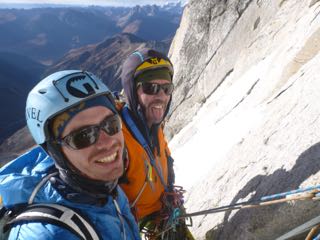
In October 2016 Ed Hannam, Mitch Murray and I embarked on a trip to the Genyen mountain range in Sichuan Province to hopefully climb an unclimbed peak and have an adventure. I’d originally met Ed on an expedition to Broad Peak in Pakistan in 2010 and we had climbing together a few times since in China (2014) and in Japan. Mitch had met Ed in Japan in March 2016 and was invited on the trip. Mitch was less experienced in the mountains but came with the right attitude, fitness and personality to fit perfectly on our trip. We were accompanied by our invaluable fourth team member Alex Tang, who would be our translator, liaison officer and driver.
We had secured a permit in July through the Sichuan Mountaineering Association for an unclimbed peak known as Hutsa and previously attempted by Dave Anderson (USA). In August, we became aware that another large team were headed to Hutsa for about a month prior to our trip. That team ended up climbing Hutsa by 2 new routes so we decided to change objectives upon our arrival. We had a few ideas and after consulting Google Earth decided on a peak in the Western area of the Genyen range that looked about 5650m high. We didn’t know what the access would be like or what the climbing would entail but it looked like a good adventure. Game on.
Ed had been carefully watching the weather patterns in the area for the past few years and concluded that from mid October to mid November was the prime time for climbing because the monsoon had finished and the winter snows hadn’t arrived yet. The colder weather also meant better ice conditions.
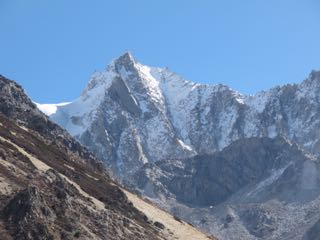
 After 3 days of driving via Kangding (2500m) and Litang (3900m), and a rapid gain in altitude, we made it to Batang (2600m) near the defined Tibetan border, our kickoff point for the expedition. The following day we crossed a 5000m pass into a beautiful open valley with a small village of Tibetan wood houses. This small village would be our step off point for the mountain, which dominated the valley above the village. This was our first view of the mountain and it was inspiring with a number of obvious possible routes that might lead to the summit. A beautiful direct line up the centre of the west face immediately caught my attention but from a distance the start of the line was obscured. Excitement levels were high. Our local guide, driver and translator, Alex, asked some of the villagers what the name of the mountain was. The mountain was known as ‘Xialong Rezha’ meaning ‘Place of wild animals with big horns’ or ‘Place of giant rocks’.
After a carry of some gear to a base camp location at 4200m, we returned to the village and slept in an abandoned compound for the night. The following morning we bid farewell Alex and headed into the mountains for the next 10 days. Our base camp was located in at the confluence of 2 rivers in a flat grassy meadow. Yaks grazed unsupervised across the river but never came to visit.
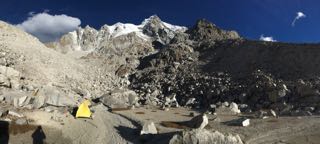
After scoping the approach to the mountain, we made an exploratory carry to the base of the mountain and found a suitable location for a high camp next to a high alpine lake. The area was amazingly pristine with no signs of any human presence in the area before. After a rest day at base camp we headed up to the high camp at 4900m with 4 days of food and fuel. The route from base camp to high camp started with a steep climb out the valley, followed by a beautiful high valley with many melt-water streams and yak pastures, and finally a steep climb up loose scree into the basin formed by the lake beneath the mountain. Sun arrived at the tents at 1030am and dropped below hills around 6pm.
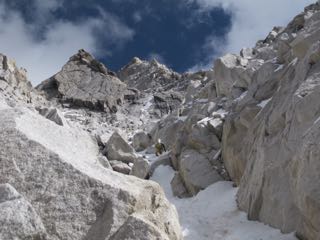
Taking things easy in order to further our acclimatization, we waited for the sun to hit camp at 1030am and then headed up to scope the approach to the route and maybe climb a few pitches in preparation for the main effort the following day. After 30 minutes of loose scree we started up the steep glacier, which led to the snow cone at the base of the couloir. The access was nearly perfect.
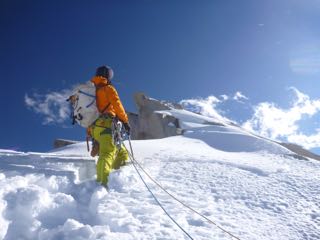
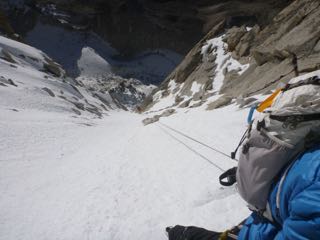
The following morning (2nd November), we left the high camp at 530am and moved quickly up the scree and glacier to the base of the mountain. We decided to lead in blocks with the two seconders climbing at the same time. Mitch led the first 3 pitches that we had climbed the previous day; Ed led the next 4 pitches and I completed the last 5 pitches to the summit. The climbing followed a couloir up the centre of the west face with mostly steep snow and ice with some icy bulges. Good rock anchors were found in the solid granite on the edge of the couloir. All the belay stances were cramped with barely enough room for 2 people standing. The nature of the route dictated that it was climbed in a long day with no bivouac. We had pushed our acclimatization schedule to the limit so the climbing was exhausting. I had to dig deep while leading my block, exhaustion setting in but the summit beckoning. The summit ridge consisted of sugar snow over rock slabs and the summit was a tottering jumbled mass of rocks so we stopped just below the top respecting the Tibetan belief that people shouldn’t go to the very top because that’s where the spirits live. We reached the top at around 4pm and began the first of 12 rappels down the line of ascent. The descent went smoothly and we arrived at our tents about 10pm tired but elated. We named the route “Standing Room Only” Its grade seemed about Scottish IV, M4, 650m)”We made a concerted effort to eat some solid food before crashing out to assist with the recovery.
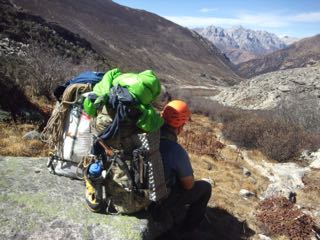
After a rest day where we consumed as much food as we could we began the grueling descent with packs weighing more than 40kg. We had double carried our gear on the way up but carrying it all down in one go was a necessary evil that just had to be done. After a break at base camp and a sleep in the sun we continued to the village where we were met by Alex and the friendly monk who lived at the edge of the village.
 We stayed in the monk’s house that night, sharing food and stories about the mountain. The monk was very interested to see our equipment and photos which confirmed that we were climbers and not hunters or miners which he originally assumed we were. He had never seen any climbers before. Our transport arrived the following morning and we headed out to Batang and promptly ordered 3 ducks for lunch from the hotel. After 2 days of hectic driving we arrived back in Chengdu ready for a rest and eager to return home.
Our small cohesive team had succeeded on an unclimbed peak in a largely unexplored area. It was the perfect adventure that yielded a perfect route on a beautiful mountain. We had been blessed with perfect clear and cold weather for the entire trip. My knee had held up to the workload without too much discomfort so I was positive for future trips into the hills. Now time to plan the next trip!
Thanks to Ed for conceiving and planning the logistics for the trip, Jiyue at Sichuan Earth Expeditions for organizing the permits and logistics, Sea to Summit for their support with gear and Cilo Gear for their support and outstanding packs.
 Rob Baker