Life sometimes gives you the opportunity to make a difference. A recent trip to Nepal provided me and some friends with opportunities for adventures and helping people. We all survived and came home with some great memories. Here is the story of that trip.
It had been 6 years since I had been to Nepal so I was keen to make another trip to a new area and climb a mountain. After some research, I decided to go to the Langtang valley; a valley with a few trekking peaks to do and relatively easy access from Kathmandu.
I put the word out to a few friends to see who was interested. Ryan, one of my long time climbing partners and Cameron, a keen green alpine climber expressed interest so we were a locked in trio.
We planned to climb Naya Kanga (5846m) which we had obtained an official permit for, however we were also interested in exploring the Langtang valley and seeing whether other harder options such as Gangchengpo (6387m) or Dorje Lhakpa (6966m) might be attractive goals for future visits.
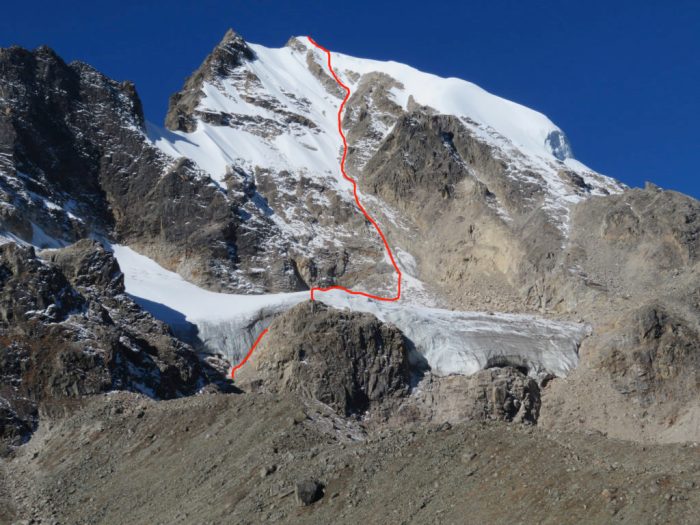
Our line of ascent up Naya Kanga
We arrived in Kathmandu in mid-October and after a day of shopping we jumped on a bus to a town called Syabru Besi (1500m) The 7 hour bus ride was on atrocious roads for the entire journey. We were joined by Sonam and Nurbu who were a fantastic help on the trip. They helped organise transport, accommodation and helped carry equipment and water up to high camp for us.
Day one of our trek from Syabrubesi (1460m) to Rimche (2455m) involved about seven hours of walking and saw us gain roughly 1000m in elevation. Donkeys accompanied us on our trek, helping to ferry our bags of climbing and camping gear up the steep track.

The following day we ascended out of the rain forested valley and made it to Langtang village which was mostly destroyed in the 2015 earthquake when a massive landslide obliterated the village. With a substantial amount of aid money the valley has been rebuilt and now has some excellent lodges and bakeries. The destruction of that event was obvious, with debris from a huge landslide completely burying parts of the old village. Memorials stood in honour of those who perished, with over 200 being an alarming number given the small size of the community. After a short day of trekking we arrived in Kyanjin (3850m) which was to serve as our base camp for the next two weeks. There were many lodges and some excellent bakeries. The views were spectacular.
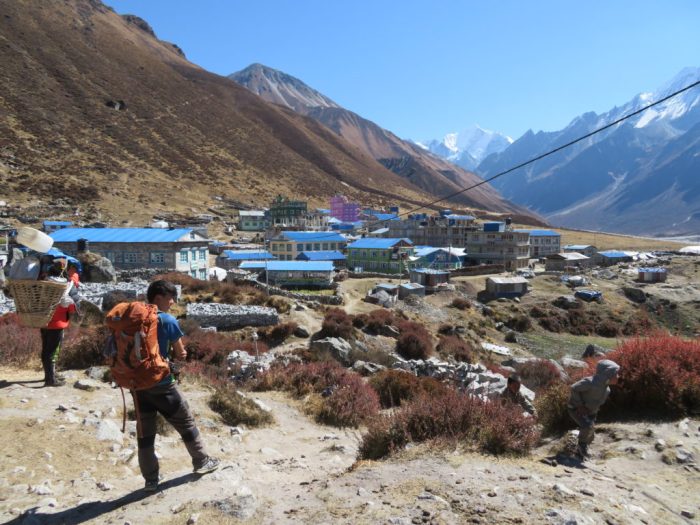
Kyanjin Gompa
After a rest day we carried some equipment up to the high camp (4900m) for Naya Kanga. It took about 5 hours up steep uphill hiking to get to the high camp located in the glacial moraine. There was no water or snow to melt for water so we made a plan to carry some water up from the base camp at 4200m.
After a long day we returned to Kyanjin and ordered some food in the lodge where we were staying. While we were waiting, Nurbu asked us me and Ryan to come and help with a woman in a nearby lodge who was suffering from severe altitude sickness. We assumed someone just had a bad headache and would likely get better with a Diamox, which we had in ample supply.
On arriving at the lodge, we found the patient totally unresponsive and unconscious. Nobody else seemed to know what to do so Ryan and I took charge. We began taking her vitals like pulse and O2 saturation levels which were at 30% (normal healthy people at sea level are near 100%). The signs, symptoms and context made it seem likely she was suffering from severe AMS, possibly with cerebral oedema. We were extremely concerned she would not survive the night if we did not get her medicine or to a lower altitude. We discussed making a stretcher to try and carry her through the night back down the valley, however decided against this as it put others at risk of injury. We knew that there was a clinic and a medic lower down the valley that might be able to help, so we sent word down the valley to ask for help.
We administered some Diamox and then asked for some of the key lifesaving essentials – injectable dexamethazone, a Gamow bag and oxygen. We also made it clear that a helicopter with doctors needed to be called for first thing in the morning. An Australian girl called Laura appeared shortly after. She was a wilderness first responder and immediately started being helpful. A Belgian couple, Dennie and Sara were also helping in any way they could. The patient was unresponsive but still moving actively so I held her upright in the bed to help her breathe properly for a few hours until the Gamow bag arrived.
Ryan and Cam went searching the village for anyone with injectable dexamethasone or bottled oxygen. No one had any of the critical medicine.
Luckily, we eventually learnt that there was a lodge owner in our village who had a Gamow bag (a portable hyperbaric chamber, pressurized with a foot pump). After a few hours the Gamow bag arrived and the doctor and oxygen system arrived from the clinic in Mundu which was a few hours walk down the valley. The dexamethasone was also administered.
We immediately prepared the Gamow bag and the patient for the Gamow bag. Being the smallest Ryan and Laura did rock- paper scissors to decide who was going to go into the bag with the patient. We found out later that this was the first recorded instance of the patient and observer in the bag together. Ryan got the first shift and was zipped into the Gamow bag with Paevi. His job was to keep her airway open and monitor the vital signs. Once in the bag, the patient’s oxygen saturation levels improved to around 50% and she became more active which also meant that Ryan copped a few elbows to the head.

Cam monitoring the patient
Using a Gamow bag is a team effort. We had a big team of Australian and Nepali volunteers rostered to keep pumping all night to keep up the pressure and oxygen flow into the bag. We recorded vitals every 20 minutes all night long and rotated shifts to share the load so we could all get a bit of sleep. At around 330 am the pump broke and Paevi was taken out of the bag and kept on oxygen.

Helping out the medics

Evacuating the casualty in the helicopter
It had been a long night for all involved but when the sun came up our patient was still alive. The helicopter arrived around 8am with an emergency doctor and medic with oxygen, drugs and all the required kit. Once stabilised, we all helped patient out to the helicopter and watched it take off. There were a few moments of silence, some warm embraces and smiles of relief
We had a rest day, caught up on some sleep and packed for the following day when we planned to head up to the high camp and make an attempt on the Naya Kanga.
After the 5 hour slog up to high camp, we set about hydrating and getting everything ready for the next few days. At nearly 5000m, it was a lot colder than Kyanjin so we were in our sleeping bags early.
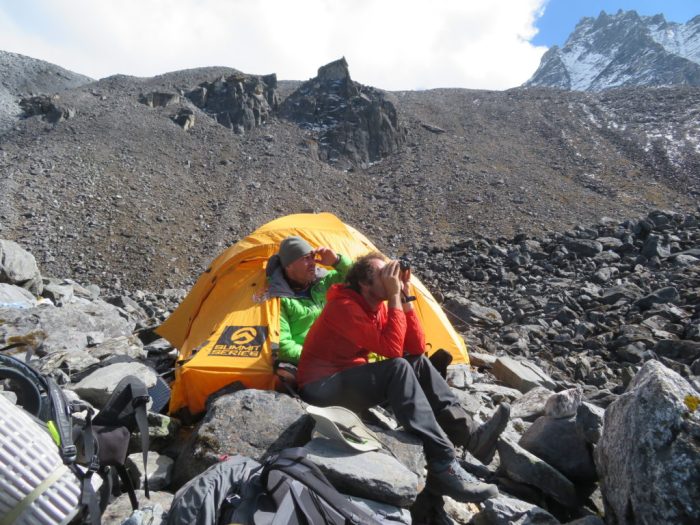
Rob and Ryan at the high camp (4900m)
The following day we set out to explore the approach to the route we intended to climb and built a lot of rock cairns along the way because we would be approaching the mountain in the early hours of the morning by headlamp. After finding a viable route and dumping some hardware we returned to camp to get an early night.
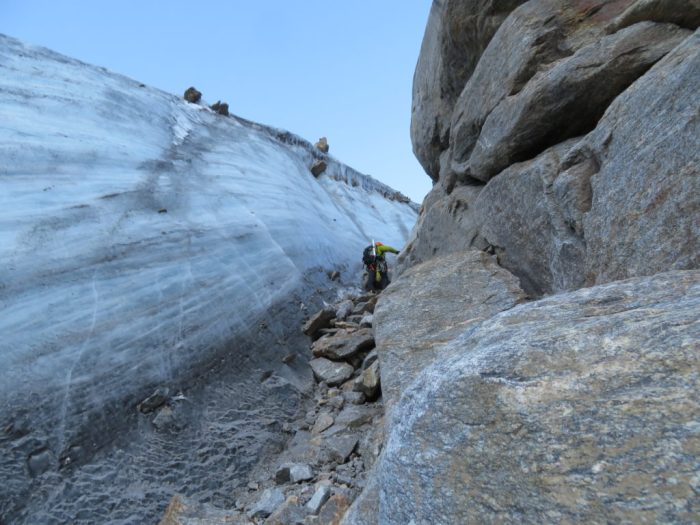
Ascending the icy gully at the start of the route
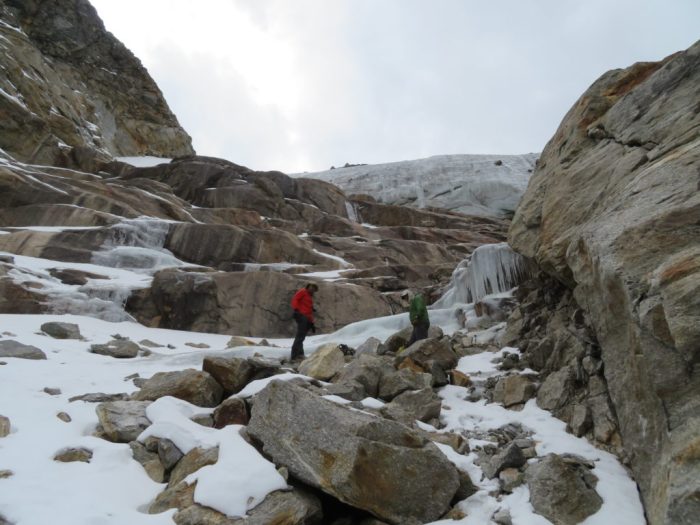
Approaching the icy gully at the start of the climbing
By 330 we were moving steadily across the glacial moraine toward the mountain. As dawn approached we started up the first of the technical climbing- low angle waterfall ice and a mixed gully that led to the glacier at the beginning of the route.
Eventually we made it to the first technical pitch on the route-a 60 m pitch of WI2 waterfall ice. Ryan took the lead and Cam and I seconded, relishing the solid ice and good pick placements.
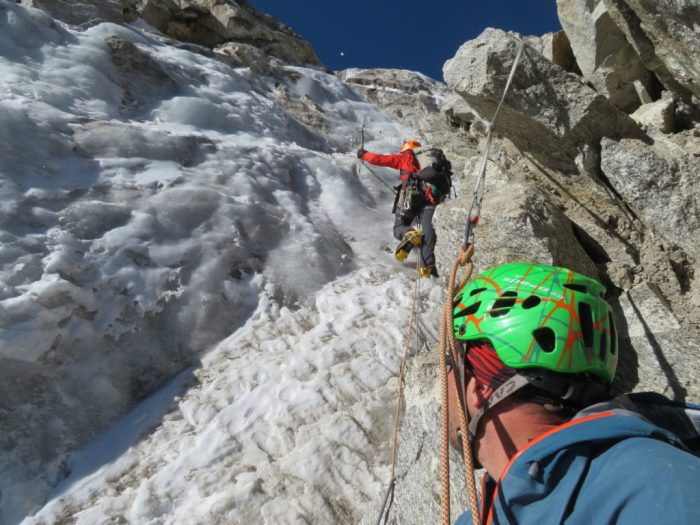
Ryan on the initial steep ice
The angle eased a bit so we coiled the ropes and began soloing the awkward terrain. There was some solid ice next to the rock but the snow had a thick crust that collapsed under every step so we had to keep close to the rock on the hard ice or risk sinking up to our knees in crusty exhausting snow.

Ryan on the early stages of the route
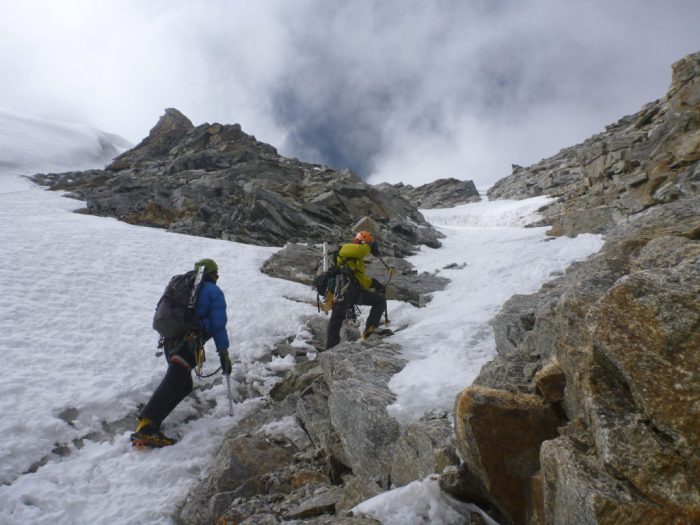
Heading toward the summit
The sun was on our backs as we steadily moved upwards. As we neared the summit, the wind got stronger and colder so we layered up with everything we angle eased slightly close to the summit then steepened again on the summit ridge. We arrived at the knife edge summit ridge about 1330. With one leg on each side of the ridge we snapped a few photos and headed down. The summit ridge was badly corniced and extremely dangerous. We had a long descent ahead of us so began immediately.


All three of us were very tired by this stage so we all remained careful and cautious. For Ryan and I, our autopilots kicked in as I led the way on the descent, building all the abseil anchors and bounce testing them before committing our weight. We kept an eye on each other and double checked each other before abseiling down.
Cam was on his first Himalayan mountain and was performing extremely well. He was careful, asked the right questions and contributed to the team in a very positive way. He also brought with him a great sense of humor which is essential for this type of endeavor.
We kept abseiling through the afternoon and into the night. The full moon rose above the mountains. The sunset was spectacular and the temperature kept dropping. We left sacrificial cord and nuts behind as our abseiling anchors. Eventually we had used so much cord that we ran out and had to start cutting pieces off one of the ropes to make anchors. After around 16 abseils we reached the glacier and the first flat ground for many hours.
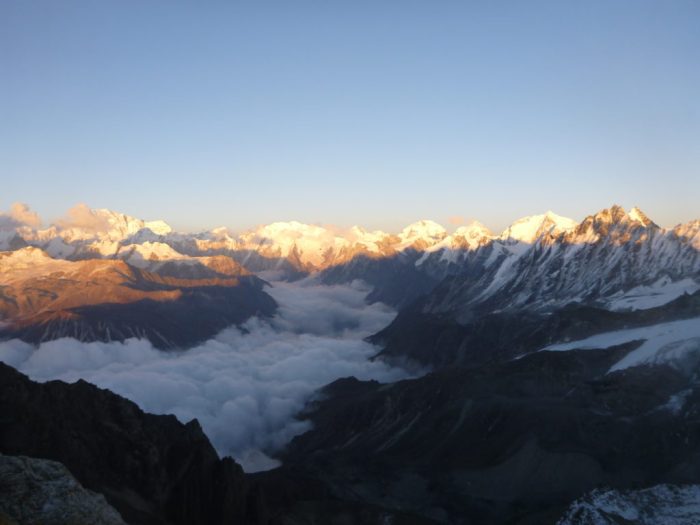
Another 2 hours of navigating back through the glacial moraine to reach our tents followed. We were quite tired by this point that we could only walk for a few hundred metres before needing to rest. We got back to the tents around 1.30am, where we dived into our sleeping bags to try and get warm. We made a hot protein and rehydration drink. The day’s effort had lasted approximately 22 hours.
The zip on my sleeping bag decided to malfunction at this point so I had a freezing sleepless night until the sun finally hit the tent in the morning.
After finishing the climb and ferrying our gear back down to Kyanjin Gompa, we had a couple of easy rest days. We got word from Laura (who had returned to Kathmandu and was able to reach us via WIFI) that Paevi who we had helped had regained consciousness and was making a remarkable recovery in hospital. She was planning to fly home with the rest of her trekking team from Finland. Interestingly, when Paevi awoke she spoke only English, not Finnish her native language. She was conscious and able to express gratitude for the first aid that had probably saved her life. This was fantastic news.
We used our time to talk to as many of some of the residents of the village about the situation with the lack of a clinic and decent medical supplies. Being such a remote and high altitude place, which has a constant stream of visitors from all over the world, it seemed likely that a similar emergency situation to what we had experienced could someday happen again. It was also possible that many Nepalese people living or travelling through the village were silently suffering from ailments that could be easily treated, yet there were no permanent facilities or people with the appropriate training who could help. We felt that having a small clinic with well-trained medics, a Gamow bag and a decent stock of medicine and equipment could have enormous benefits for this community, which depends so much on tourism for its income. Such a project might also help raise the profile of this beautiful valley, and help to provide a safety net for unacclimatised tourists who get in trouble with acute mountain sickness.
We spent one of our rest days going for a leisurely walk further up the valley. This was the most spectacular part of the area, and gave us clearer views of some truly magnificent peaks. Gangchempo (6378m), Langshisa Ri (6560m), and Pemthang Karpo Ri (6865m) dominated our view to the east, whilst the giant pyramid of Langtang Lirung (7227m) dominated the skyline in the west. What we saw from our short stroll only scratched the surface.
The following day we began the 2-day walk out to Syru Besi and the journey back to Kathmandu and home to Australia. It had been a great trip with some great friends in a beautiful part of the world.
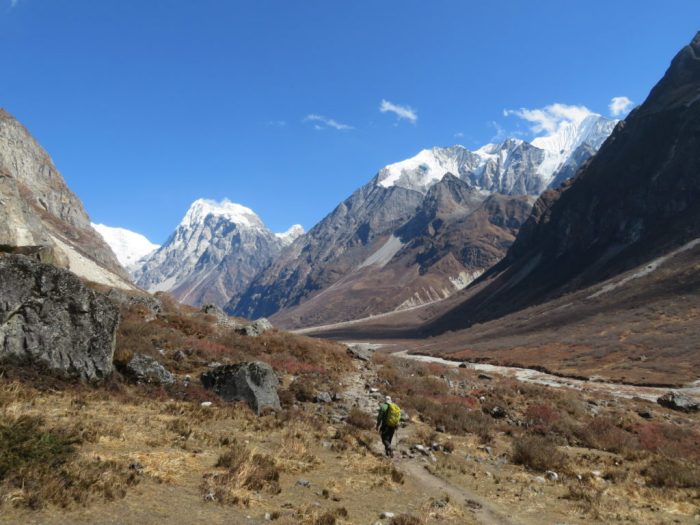
Exploring the upper valley.

Cam and Tsering in the Dorje Bakery
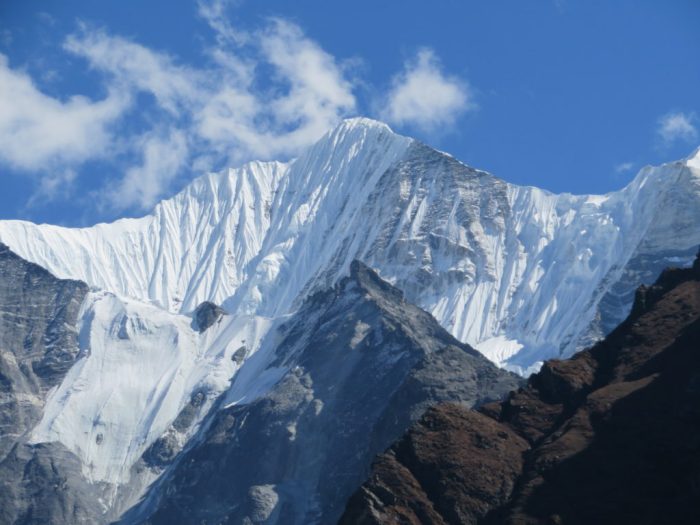
Gangchempo – one of the most beautiful mountains in the valley

the team in Sybrubesi- Cam, Ryan, Nurbu, Sonam, Rob
If you would like to Donate to the Kyanjin Health Post Project, see link below
http://www.sustainablesteps.org/initiatives/kyanjin-health-post/
Donate here
 Rob Baker